All music presented on this site is shared under the premise of "fair use"; this site is solely intended for the purpose of education and critique. If you are a rights holder to any of the music presented and wish for it to be removed, simply contact me directly and it will be taken down.
Looking for an instant collection? MANY great soul titles with a 79 cent starting bid!!!! Plus, I added a few dozen more excellent titles with sound clips.
Happy bidding! Mention that you are a visitor to this site and I'll give you an even better deal with shipping on multiple items.
Seemingly the only release from this group. Given that the producers are Richard Parker and Sonny Sanders I am assuming that they were based out of Chicago (which the sound certainly backs up).
The song itself is a gorgeous salute to one of the most maligned figures in all relationships- the mother-in-law/ girlfriend's mother. A very classy and heartfelt.record!
From Dallas Texas, Willie Hutch(inson) moved to Los Angeles shortly after high school and (while not a household name) had a very successful career.
Around 1967, Willie began working with hit makers The 5th Dimension, and also found some of his original tunes covered by Motown artists (including the massive hit "I'll Be There" by the Jackson Five). In the 70's, Willie's name was attached to the soundtracks of some classic blaxploitation films, "The Mack" being the most famous of the bunch.
This excellent single was released under his own name right around the time he was in the early stages of his songwriting career, and finds him in excellent, powerful voice with some fabulous musical backing behind him.
Josephine Taylor hails from Evanston, IL (a university suburb just north of Chicago) and she cut a handful of singles between 1966-69, and sadly hasn't been heard from since (although there are rumors that she occasionally sings gospel in public in Chicago).
This single, her final release, is just staggering! "Is It Worth A Chance" is pure fire, typical of the best Syl Johnson productions. The b-side is a gorgeous ballad; both sides showcase the remarkable voice of this woman who left behind precious few incredible records.
This is possibly the most mysterious record I have ever featured on this site!
One fact that is almost a given with records is that, in the run out groove/ dead wax area, there's a matrix number that is the record's identification. These numbers, which almost always apply to the mastering catalog system, can be very helpful in both dating a record and also differentiating fakes from the real thing. This record has NO matrix number, which I have never seen before. Not only THAT, but there is no songwriter and no publisher listed on the label! Very, very strange! The song is a re-working of the 1961 Dee Clark hit, but I REALLY dig this uptempo version far better. How they got away without listing the writer and publisher just boggles my mind!
The one name that *is* listed is producer Mel Friedman; Mel was most certainly based in St Louis, MO. Mel's claim to fame was behind the boards for Bob Kuban & The In-Men's classic "The Cheater', which was a big hit right around the time this record was released (luckily there's at least a catalog number present on the label).
I would say almost certainly that this is not the same Profiles that were based in Detroit.
Pearl Woods biggest claim to fame is writing the massive "Something's Got A Hold On Me", as cut by Etta James (she also penned "Poverty", recorded by Bobby Bland).
This track, the top side of which is also self-penned, finds the South Carolina native had a fantastic, sexy and powerful voice of her own. The flip side is a stellar cover of the Doc Pomus written Ray Charles classic "Lonely Avenue".
Pearl recorded a small handful of singles up until 1965, and one more in 1970. She seems to have vanished from the music business at that point, leaving a VERY impressive cache behind.
While it's relatively well known that Charlie Rich cut some of the greatest blue-eyed, red-necked soul records of the sixties, it seems that the r&b sides cut by Carl Perkins are relatively unknown. A pity, as this track still retains Carl's country/ rockabilly roots but put it into the then-modern framework of a record that could easily be played at the local a-go-go. Artists who got their start in the fifties were getting lost in the shuffle of the musical changes of the sixties, and some had more success than others in adapting (just as it took Elvis until 1968 to "get with it", and when he did he cut some of his greatest records).
Just DIG that Hammond organ grooving alongside Carl's guitar pickin'; a mighty fine example of musical integration!
Singer Jesse James was transplanted from Arkansas to right here in the bay area when he was a child, thanks to his father finding work as a fisherman. In his early 20's Jesse (real last name McClelland) adopted the stage name Jesse James and became a working musician, and also cut some sides with the help of Sylvester Stewart (aka Sly Stone).
This excellent ballad shows off his deep southern vocal roots that are seemingly straight out of the church, with a brilliant arrangement as well.
Notice the sticker on the label from "The Hosea"; from what I can gather, "The Hosea" was a west coast radio promotion man, hired by labels to get their records played on the radio. I've found other records locally with similar stickers.
This great record is out of St Louis, MO, and that's about all I know!
St Louis producer Oliver Sain's name is on the label, which is one of those magic names that almost guarantees a record to be interesting, if not BRILLIANT in the case of this one. Thanks to an online database of radio surveys, I found that this record charted locally in St Louis in early '67.
The Soul Blenders had a few later releases, and they seem to be an offshoot of a group called The Tabs that I know very little about. Something else to investigate!
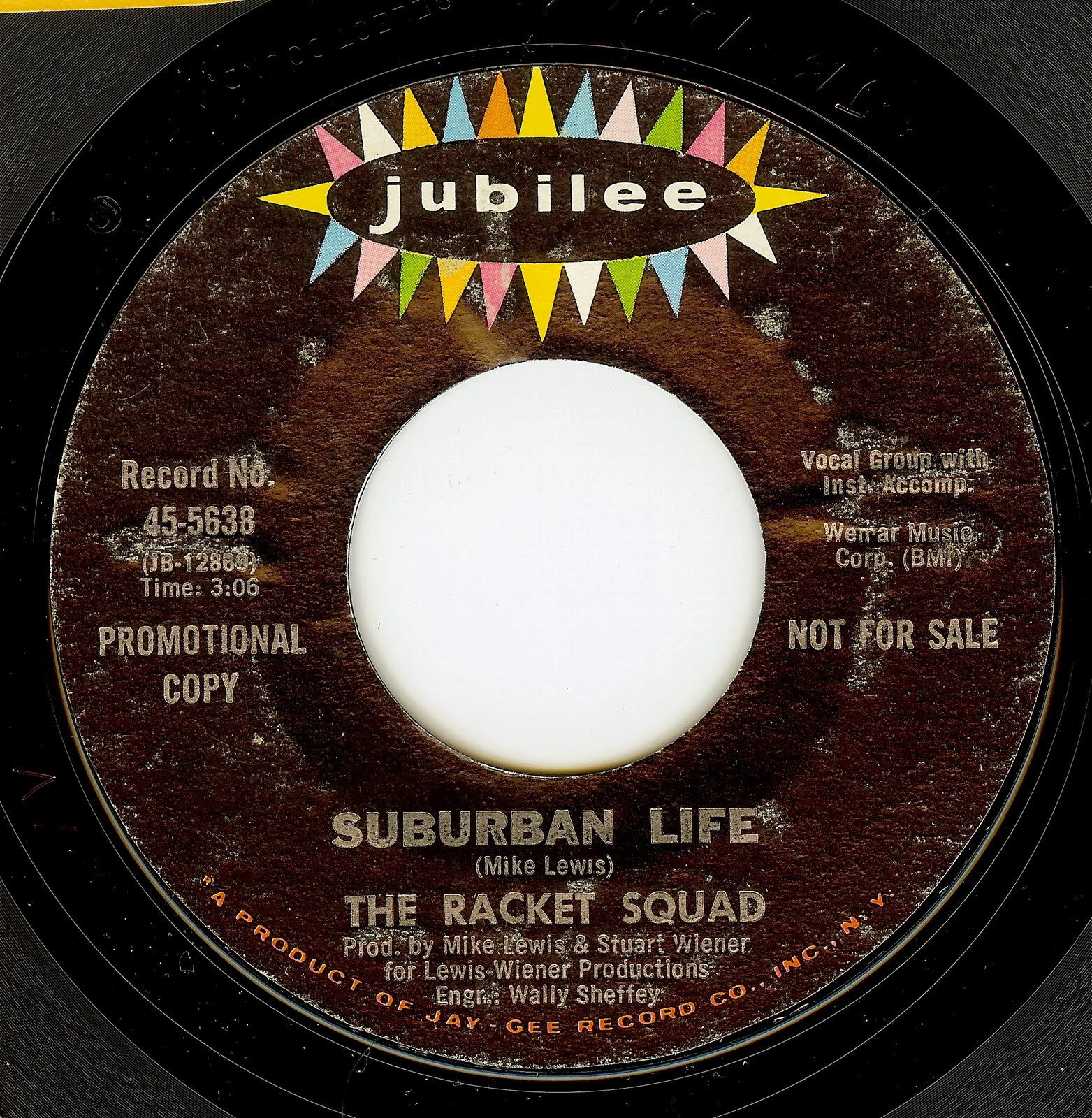
Morphing into the psychedelic bag from vocal groups (The Four Chaps, The Townsmen & The Fenways) in the Happenings/ Four Seasons mode, The Racket Squad were basically straight out of the Pittsburg, Pennsylvania suburbs. The Four Chaps worked for a time as backing singers on TV's "Shindig!" in 1964-65.
Everything gels together on this track; the group's r&b influences match perfectly with their own brand of psychedelic exploitation for a 3 minute blast with superhuman drumming and a groove that predates the hypnotic sound of German bands such as Can and Neu, all matched with excellent lyrics that provide an even more cynical alternative to "Pleasant Valley Sunday".